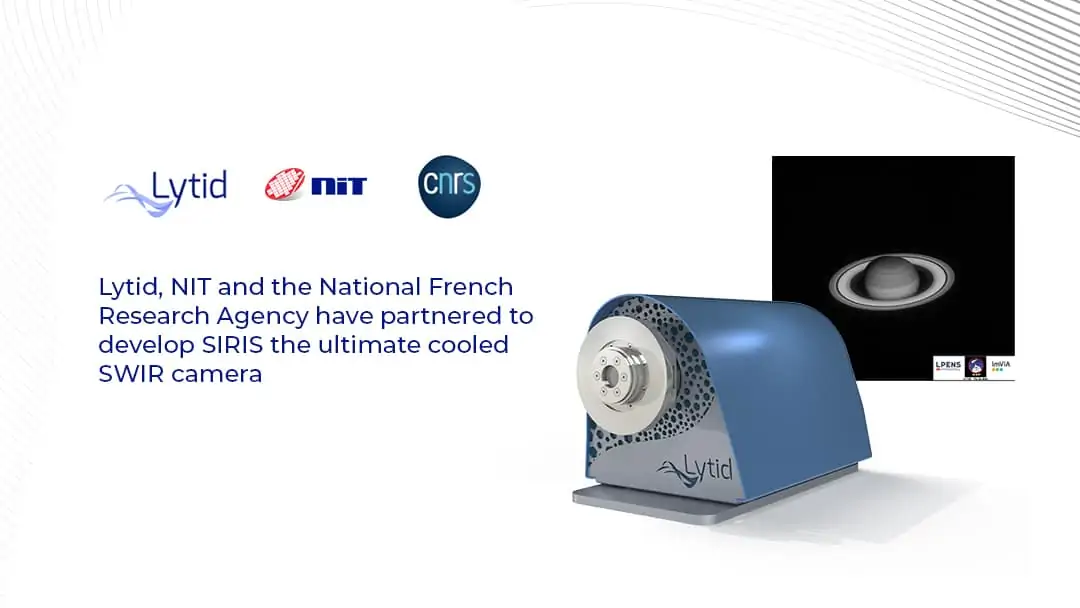
Lytid, NIT and the National French Research Agency have partnered to develop SIRIS the ultimate cooled SWIR camera

Mar 30, 2021 | News

Lytid has released the SIRIS SWIR camera – a deep cooled SWIR camera based upon a Lin/Log InGaAs sensor from NIT and image processing algorithms from the French Research Agency (CNRS).

SIRIS exhibits the best performance on the market for read-out noise (<10e-) and dynamic range (>120dB) simultaneously, thanks to NIT Lin/Log 1601 SWIR sensor. SIRIS is deep cooled down to 50K with a long-life cryocooler allowing a drastic reduction of dark current. Exposure time over one hour can be easily obtained. Everything is fully integrated into a compact and plug-and-play casing based on Lytid’s advanced photonic system integration.

Moreover, SIRIS incorporates advanced noise reduction algorithms developed by ENS-CNRS, among which non-destructive read-out noise reduction is embedded. The resulting noise performance is drastically reduced and the final readout noise is less than 10e-.

Applications for SIRIS cover high-end imaging such as astronomical research, bio-medical imaging, bioluminescence…
Recent news

SWIR for Earth Observation

SWIR for Earth Observation

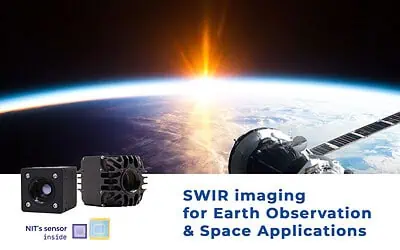
SWIR for Earth Observation and Space Applications Short-Wave Infrared (SWIR) imaging is playing an increasingly important role in Earth observation and space applications, enabling advanced analysis capabilities across environmental monitoring, industrial inspection,...

SWIR Imaging for Firefighting UAVs and First Responders

SWIR Imaging for Firefighting UAVs and First Responders

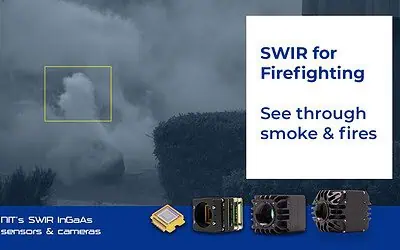
SWIR for Firefighting In the chaos of a fire, every second counts—but smoke can blind even the most experienced firefighters. Traditional visible light cameras struggle in dense smoke, haze, or dust, leaving first responders at a disadvantage when they need clarity...

Enhancing Counter-UAS Capabilities with SWIR Imaging

Enhancing Counter-UAS Capabilities with SWIR Imaging

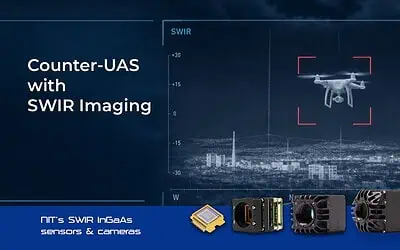
The Challenge of Détection and Identifying Small Drones The rapid adoption of small unmanned aerial systems (UAS) across both commercial and non-cooperative applications has significantly increased the need for effective counter-UAS (C-UAS) solutions. However,...