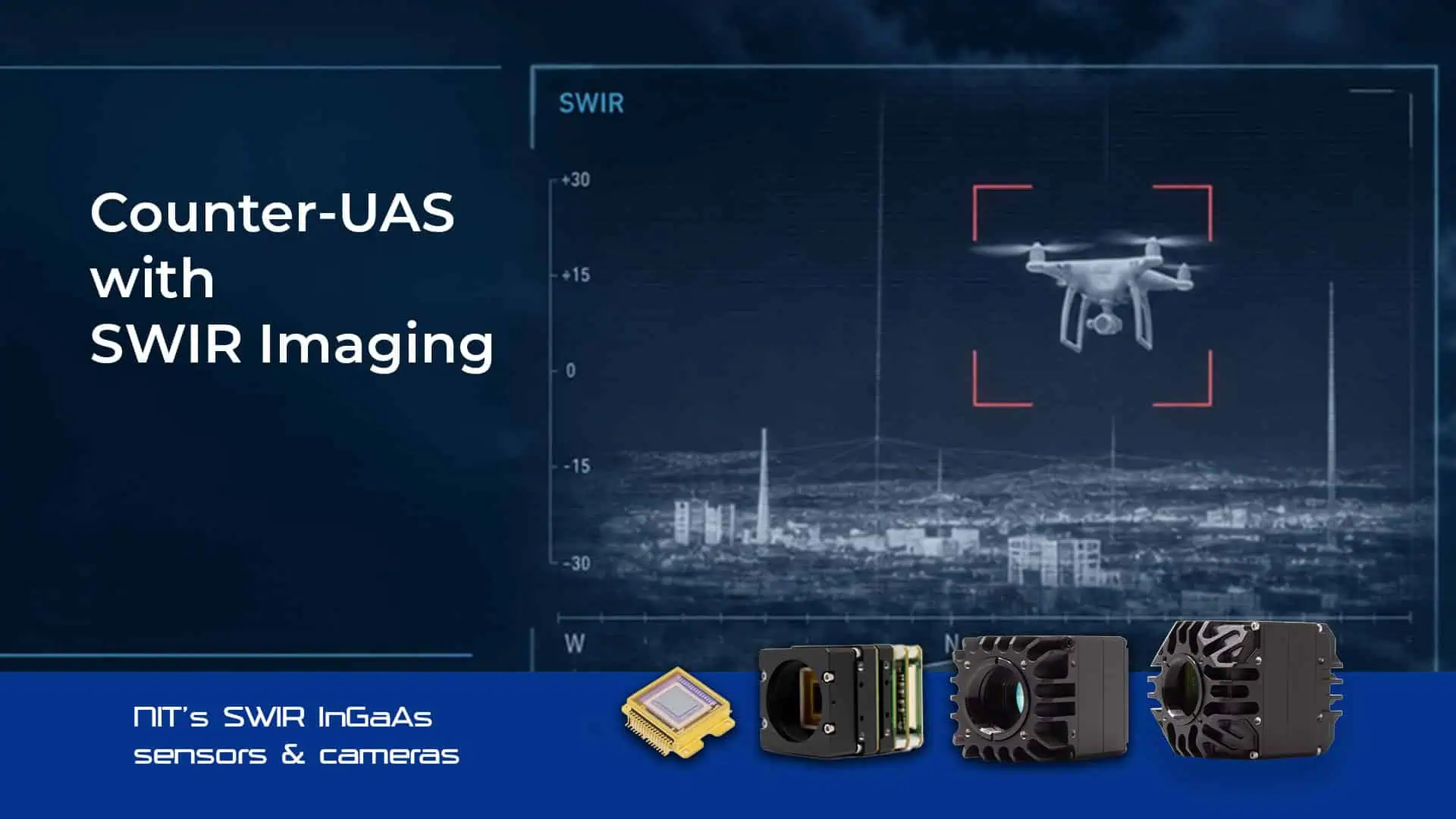
The Challenge of Détection and Identifying Small Drones
The rapid adoption of small unmanned aerial systems (UAS) across both commercial and non-cooperative applications has significantly increased the need for effective counter-UAS (C-UAS) solutions.
However, detecting and identifying small drones remains a complex task. These platforms typically present:
- Low radar cross-section (RCS), making them difficult to track
- Low contrast targets, especially against bright or cluttered sky backgrounds
- Operation in complex environments, including urban areas and degraded visibility conditions
While multiple sensing modalities are often combined in C-UAS architectures, achieving reliable identification – not just detection – remains a key challenge.
SWIR Solutions as a Complementary Sensing Layer
SWIR sensors and cameras are increasingly integrated as a complementary imaging layer within C-UAS systems, alongside radar, visible, and thermal technologies.
Operating in a reflective imaging regime, SWIR shares similarities with visible imaging while offering enhanced performance in conditions where standard cameras are limited.
Key Advantages of SWIR Solutions for Counter-UAS
- Better contrast against sky in certain lighting conditions
SWIR sensors can improve the visibility of drones against bright or hazy skies, where visible imaging often struggles with low contrast. - Material reflectivity differences
Drone components such as plastics, composites, and coatings exhibit distinct reflectivity in the SWIR band, enabling improved target differentiation and supporting identification. - Reduced atmospheric scattering vs visible
SWIR wavelengths are less affected by haze and atmospheric effects, helping maintain image clarity in degraded environments and at longer stand-off distances.
Extending Capabilities with Gated SWIR Imaging
SWIR solutions can be combined with gated imaging techniques to further enhance detection and identification capabilities.
By leveraging very short exposure times synchronized with active illumination, gated SWIR imaging enables the selective acquisition of reflected light from a defined distance range. This allows the system to suppress background and focus on targets of interest.
This approach supports:
- Day/night operation and all-weather capability using a single sensor
- Improved identification through enhanced target visibility
- Target discrimination in cluttered scenes
- Extended observation range with improved scene clarity
Illustrative example: gated SWIR imaging can reveal the structure of a drone at a distance, improving identification compared to conventional imaging approaches.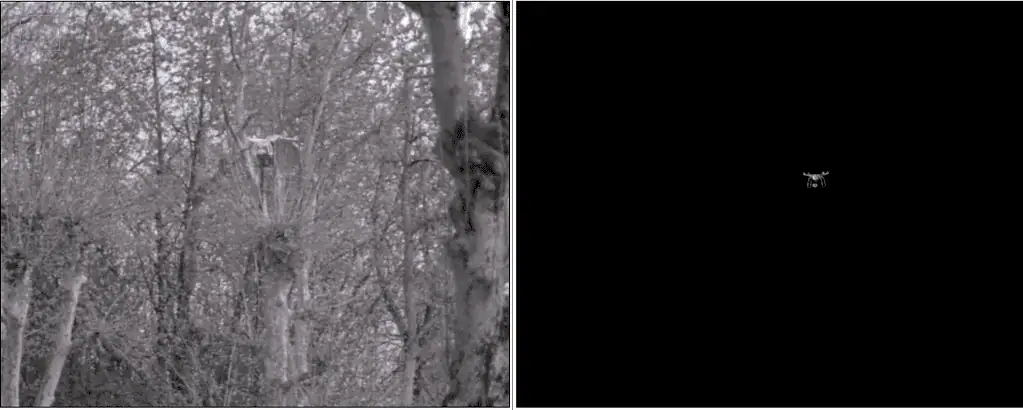
SWIR Image shot with WiDy SenS 640
Positioning vs Thermal Imaging in Counter-UAS system
Thermal imaging remains a key technology for detecting heat signatures and is often used as a detection channel, or complemented by radar or acoustic solutions in C-UAS systems.
SWIR solutions provide a different type of information:
Thermal imaging
- Detection of heat signatures
- Effective for initial detection
- Limited structural detail in certain scenarios
SWIR imaging
- Captures reflected light
- Provides shape, structure, and reflective features
- Supports improved identification and classification
Rather than replacing thermal imaging, SWIR acts as a complementary layer, particularly valuable when moving from detection to identification.
Supporting Identification in Complex Environments for Counter-UAS
C-UAS systems must operate across a wide range of conditions, including:
- Bright daylight with complex backgrounds
- Degraded visibility due to haze or atmospheric effects
- Long stand-off distances
- Cluttered scene environments
In these scenarios, SWIR solutions help maintain target contrast and clarity, enabling more reliable identification and decision-making.
NIT’s High-Performance SWIR Solutions for Integration
NIT develops high-performance SWIR sensors and cameras designed for integration into unmanned systems and security platforms.
Key features include:
- Resolution from qVGA to Full HD
- Very short exposure times down to 100 ns, enabling gated imaging
- High dynamic range up to 120 dB for challenging lighting conditions
- High sensitivity, supporting imaging in low-signal environments
To meet different integration requirements, NIT’s SWIR solutions are available in multiple formats:
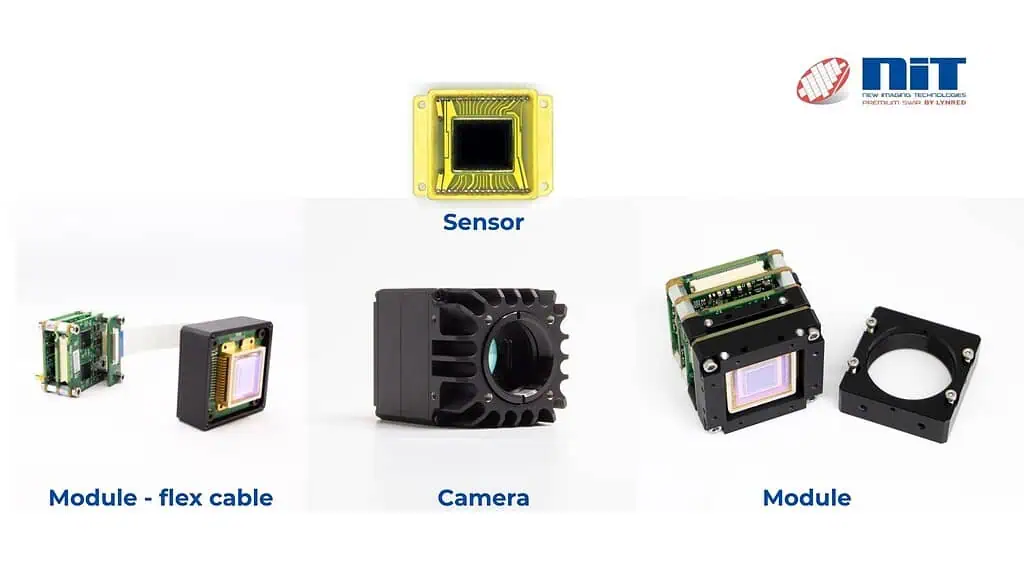
- Sensor-level
- Board-level
- Camera modules (with or without housing)
A range of standard interfaces ensures compatibility with existing systems:
- USB3.0
- CameraLink
- HD-SDI
- GigE
- Analog
- Conclusion
As counter-UAS requirements continue to evolve, the ability to move beyond detection toward reliable identification is becoming increasingly important.
NIT’s SWIR solutions provide a valuable complementary imaging capability, offering enhanced contrast, reduced sensitivity to atmospheric effects, and access to structural and material information.
By integrating SWIR into multi-sensor architectures, system designers can strengthen identification performance—particularly in scenarios where traditional sensing technologies struggle.