SWIR for SATCOM: Enabling Free-Space Optical Communication in New Space
The rapid expansion of satellite communications is driving a shift toward optical (laser-based) communication systems, where Short-Wave Infrared (SWIR) technologies are emerging as a key enabler. As New Space ecosystems accelerate—particularly in Low Earth Orbit—SWIR sensors are increasingly deployed to support high-speed, secure, and reliable data transmission.
SWIR for SATCOM: at the Core of Free-Space Optical Communication
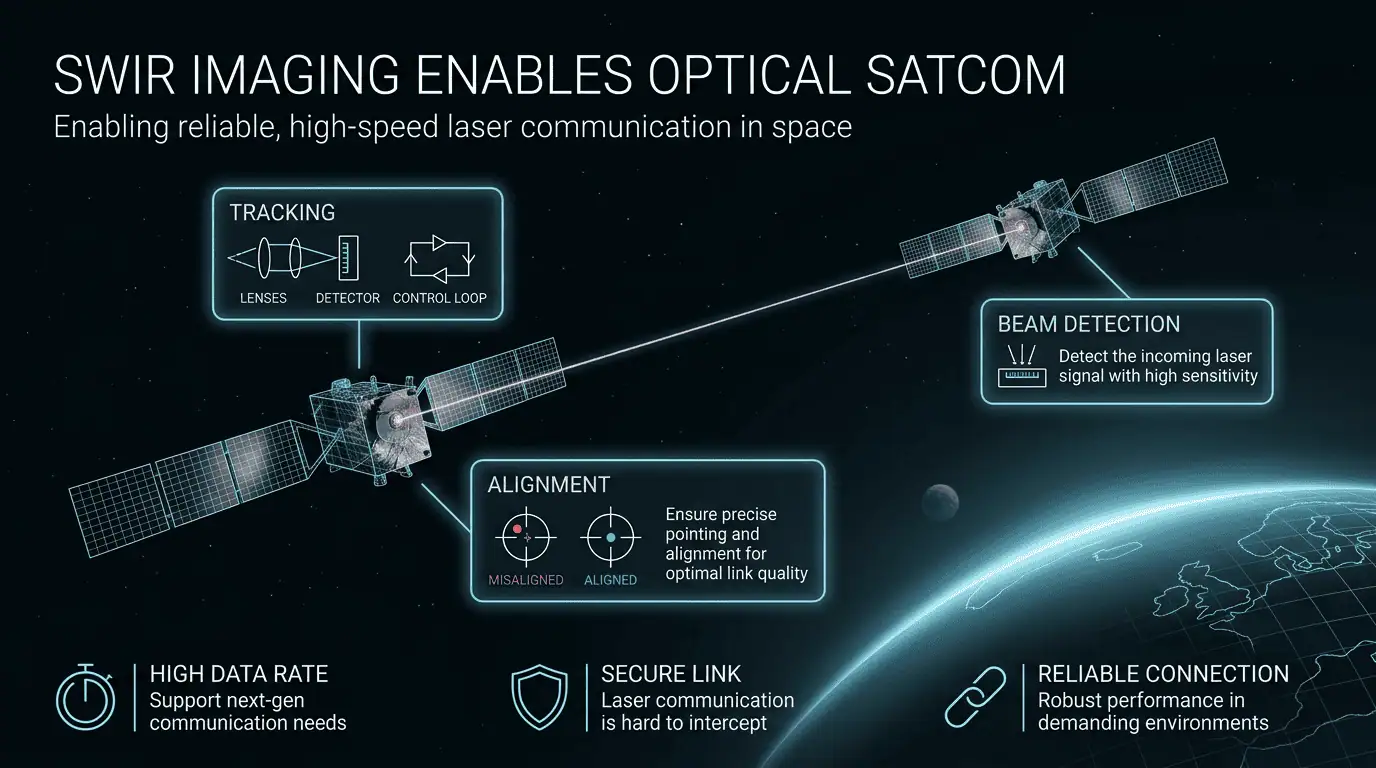
SWIR imaging plays a critical role in Free-space optical communication systems. Unlike traditional RF communications, FSO relies on laser beams to transmit data between satellites or between satellites and ground stations.
In this context, SWIR sensors enable:
- Precise beam detection and tracking
- Accurate alignment of optical links
- Reliable signal acquisition in dynamic environments
These capabilities are essential for maintaining stable, high-bandwidth communication links in space.
SWIR for SATCOM: Why 1.55 µm is the Preferred Wavelength
The 1.55 µm wavelength has become the standard for SATCOM optical systems due to several advantages:
- Excellent atmospheric transmission
- Compatibility with existing laser technologies
- Eye safety for ground-based operations
SWIR sensors optimized for this wavelength provide the performance required for long-distance, high data-rate communications.
LEO Constellations Driving SWIR Adoption
The rise of large-scale satellite constellations in Low Earth Orbit is reshaping the SATCOM landscape. These systems require:
- Compact, lightweight payloads
- Low power consumption
- Cost-effective, scalable components
This shift is accelerating demand for commercial off-the-shelf (COTS) SWIR solutions, capable of meeting performance requirements while remaining economically viable.
SWIR for SATCOM: NIT Developments
New Imaging Technologies (NIT), part of LYNRED is actively contributing to this evolution by developing SWIR solutions tailored for optical communication applications.
NIT technologies have already been implemented in:
- Aerial free-space laser communication systems
- Demonstrators targeting LEO environments
In parallel, NIT has initiated space qualification programs for its SWIR sensors. Early results show:
- Stable behavior of the ROIC (Read-Out Integrated Circuit) under radiation
- Reliable performance of detectors based on Indium Gallium Arsenide
SWIR for SATCOM: NIT SWIR Cameras
To support SATCOM and FSO applications, NIT offers high-performance SWIR cameras designed for precision and speed:
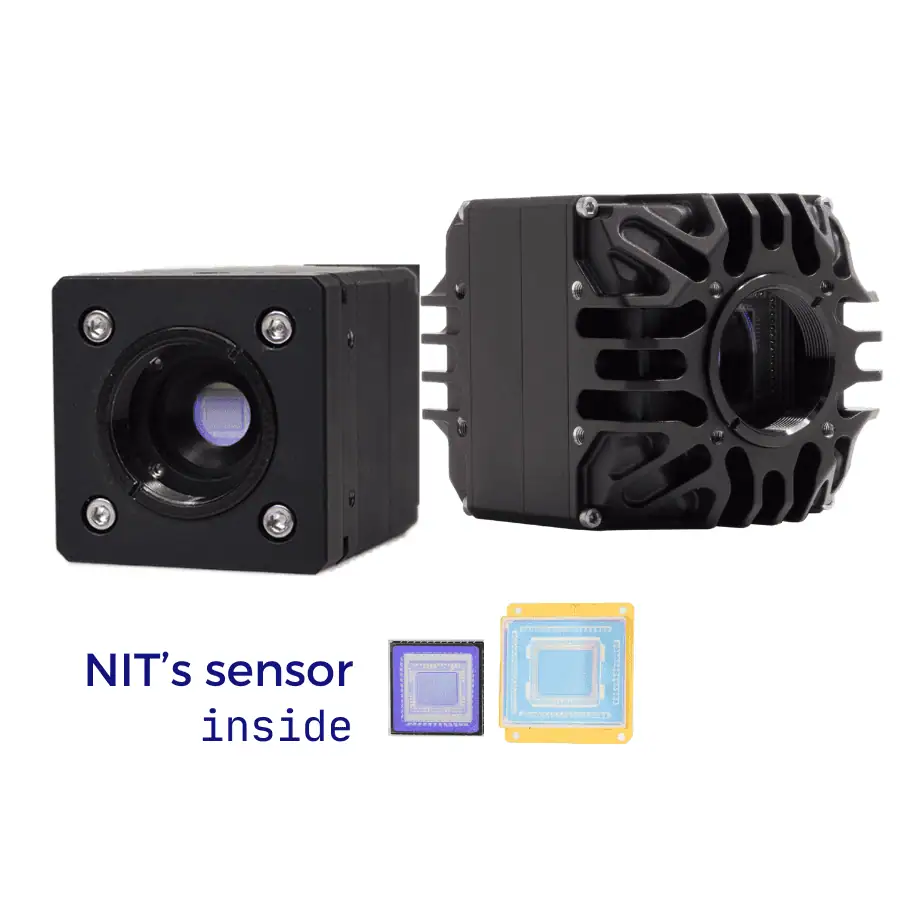
WiDy SenS 320 – High-Speed SWIR Camera
- High frame rates for real-time beam tracking
- Optimized for dynamic optical communication systems
- Compact and efficient for embedded platforms
SenS 1920 – Full HD SWIR Camera
- High-resolution for signal monitoring and diagnostics
- High-sensitivity for low-light detection
- Suitable for long-range optical link analysis
Conclusion: SWIR Enabling the Future of Optical SATCOM
As satellite communications transition toward laser-based systems, SWIR technologies are becoming indispensable. Their ability to deliver precision, sensitivity, and reliability makes them ideal for the demands of modern SATCOM—especially in LEO constellations.
With ongoing advancements in sensor performance and space qualification, New Imaging Technologies supports the next generation of free-space optical communication systems.
SWIR imaging solutions
Contact NIT today for more information about our SWIR imaging solutions for SATCOM applications.