
SWIR for Earth Observation and Space Applications
Short-Wave Infrared (SWIR) imaging is playing an increasingly important role in Earth observation and space applications, enabling advanced analysis capabilities across environmental monitoring, industrial inspection, and scientific research.
As space missions evolve, SWIR sensors are becoming essential components of multi-spectral imaging systems, delivering unique insights beyond the visible spectrum.
SWIR for Earth Observation – Spectral Requirements
Earth observation applications require a broad spectral range depending on the target. SWIR typically covers wavelengths from:
- 900 nm to 1.7 µm (standard SWIR)
- Up to 2.5 µm for extended SWIR applications
This spectral diversity enables:
- Vegetation and moisture analysis
- Mineral and material identification
- Water content monitoring
The wider the spectral coverage, the more applications it can address, though often at increased system complexity and cost.
SWIR for Earth Observation – SWIR Sensor Technologies for Space
Two main technologies dominate SWIR imaging for space:
- Indium Gallium Arsenide
- Advantages: Sensible, reliable, relatively low cooling requirements, and cost-effective
- Ideal for many LEO Earth observation missions
- Mercury Cadmium Telluride
- Extended spectral range up to 2.5 µm
- Higher performance but requires cooling and higher budgets
The choice between these technologies depends on mission requirements and constraints, including budget, performance needs, and orbital environment.
SWIR for Earth Observation – LEO vs Geostationary Orbit Applications
SWIR system design varies significantly depending on the orbital environment:
- Low Earth Orbit (LEO)
- Focus: Cost-efficiency, compactness, and scalability.
- Demand Drivers: The rise of New Space constellations has increased the need for affordable, high-performance SWIR solutions.
- Geostationary Orbit
- Focus: Priority on performance and spectral range
- Technology: Typically uses advanced, cooled detector technologies to ensure optimal data quality over extended periods.
Extended SWIR (E-SWIR): Opportunities and Trade-offs
Extended SWIR technologies enable broader application coverage but introduce challenges:
- Lower quantum efficiency in some approaches (e.g., quantum dots)
- Increased cooling requirements for high-performance solutions
To address these needs, NIT is developing new adapting solutions.
Technical Constraints in Space-Based SWIR Imaging
SWIR systems for space must balance several factors:
- Radiation tolerance for long-duration missions
- Cooling requirements vs. noise performance
- Spectral coverage vs. cost
These trade-offs are central to system design and influence technology selection for each mission.
SWIR as Part of Multi-Spectral Imaging Systems
SWIR for Earth observation does not operate in isolation. Instead, it complements other imaging technologies to create comprehensive data sets. Modern Earth observation payloads often integrate:
- Visible imaging
- Thermal infrared
- Hyperspectral sensors
SWIR contributes:
- High sensitivity in low-light conditions: Enabling data collection during dawn, dusk, or under cloud cover.
- Strong atmospheric transmission: Penetrating atmospheric interference to deliver clear, accurate images.
- Enhanced material discrimination capabilities : Distinguishing between materials with similar visible characteristics but distinct SWIR signatures.
SWIR for Earth Observation – NIT solutions
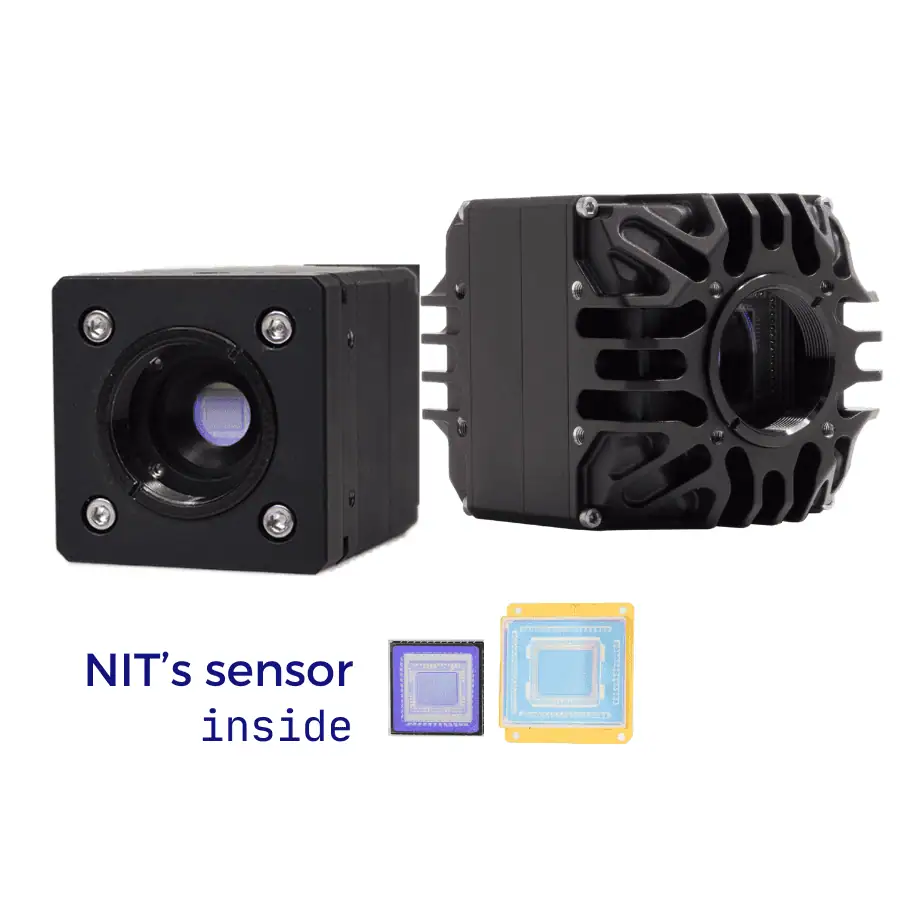
New Imaging Technologies (NIT) offers SWIR cameras designed to meet the demands of space and Earth observation applications:
SenS 1920 – Full HD High Sensitivity SWIR Camera
- Full HD resolution for detailed imaging
- High sensitivity and low noise
- Ideal for Earth observation and scientific missions
WiDy SenS 320 – High-Speed SWIR Camera
- High frame rates for dynamic scene capture
- Suitable for real-time monitoring and tracking applications
These solutions combine performance, compactness, and scalability, making them well suited for New Space missions.
Conclusion: SWIR for Earth Observation – Enhancing Capabilities
SWIR imaging is becoming a critical technology for advanced Earth observation, enabling new levels of insight across a wide range of applications.
As demand grows for multi-spectral, high-performance, and cost-efficient space systems, New Imaging Technologies (NIT), SWIR Business Unit of LYNRED, continues to develop solutions that address the market’s evolving needs.
SWIR for Earth Observation
Contact NIT today for more information about our SWIR imaging solutions and for Earth Observation & Space Applications