NIT has designed a specific “Soft Trigger” mode for its flagship WiDy SenS VGA InGaAs SWIR GigE Vision camera

Mar 4, 2020 | News

For high-speed industrial inspection solutions, the processing time is critical to increasing production throughput.

To fulfill the need for a fast and precise process monitoring, NIT has designed a specific “Soft Trigger” mode for its flagship WiDy SenS VGA InGaAs SWIR GigE Vision camera. This mode reduces the latency between the beginning of the exposure time and delivery to the host system of the produced image. Therefore, the inspection system increases the checking rate.


About our semiconductor inspection solution
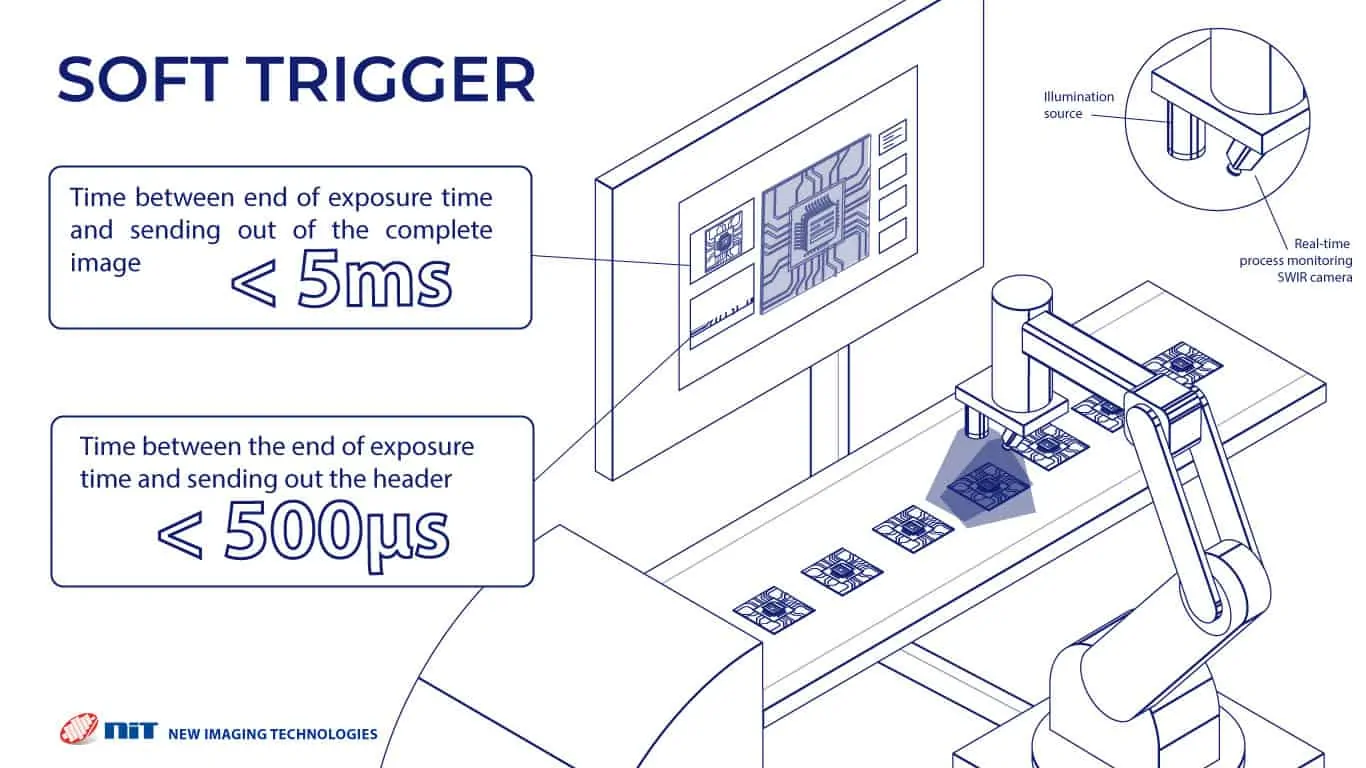
NIT soft trigger illustration

This ITR mode includes the pixel Non-Uniformity Correction, the bad pixel replacement, and the Histogram equalization. The WiDy SenS GigE camera series provide an 8bit image output with reduced latency. The time between the end of exposure time and sending out the header is < 500µs. Hence, the time between the end of exposure time and sending out of the complete image is less than 5ms.

This option makes the WiDy SenS well adapted to your inspection system.

Recent news

Meet NIT at the Industry’s Key Imaging Events This Fall

Meet NIT at the Industry’s Key Imaging Events This Fall

NIT's events 2026 This autumn, New Imaging Technologies (NIT), part of LYNRED, will be showcasing its latest short-wave infrared (SWIR) imaging solutions (0.9-1.7 µm) at several key industry events across machine vision, semiconductor, defense, aerospace, and...

SWIR for Earth Observation

SWIR for Earth Observation

SWIR for Earth Observation and Space Applications Short-Wave Infrared (SWIR) imaging is playing an increasingly important role in Earth observation and space applications, enabling advanced analysis capabilities across environmental monitoring, industrial inspection,...

SWIR Imaging for Firefighting UAVs and First Responders

SWIR Imaging for Firefighting UAVs and First Responders

SWIR for Firefighting In the chaos of a fire, every second counts—but smoke can blind even the most experienced firefighters. Traditional visible light cameras struggle in dense smoke, haze, or dust, leaving first responders at a disadvantage when they need clarity...